The short answer
There are 193 United Nations member states, 197 countries on the list most travellers use, and 249 entries in the ISO 3166 country-code standard. No number is a mistake; each one draws the line in a different place, and the disagreement is about sovereignty and about territories, not about geography.
Which one you should use depends on what you are counting. For a geopolitics essay, 193. For a travel record, 197 is the convention. For collecting territories the way the long-haul clubs do, 249.
Why the UN says 193
193 is a membership figure, not a census of the world. It counts the states that have been admitted to the United Nations — the strictest, cleanest and least arguable definition, which is exactly why institutions use it.
It leaves out places you can very much fly to, sleep in and get a stamp from. Vatican City and Palestine hold permanent observer status rather than membership; Taiwan is not a member; Kosovo is recognized by many states but not seated. None of that changes whether you have been there.
Why travellers say 197
197 is the travel community's working answer: the UN's 193 plus the observer states and the de-facto states that function as countries when you actually go — their own border, their own stamp, their own capital.
It is a convention rather than a law, which is why you will occasionally see 195 or 196 instead, depending on whose list you read and which disputed cases it admits. What matters for a personal record is that the number is stated alongside what it contains.
Why a computer says 249
249 is the count of two-letter codes in ISO 3166-1 — the standard behind country dropdowns, domain suffixes and shipping forms. It includes dependencies and overseas territories: Greenland, Guam, Réunion, the Falklands, Aruba and dozens more.
For a traveller this is not padding. Getting to Svalbard or French Guiana is a real journey, and counting them is a legitimate way to keep score — it is simply a different sport from counting sovereign states.
So how many have you visited?
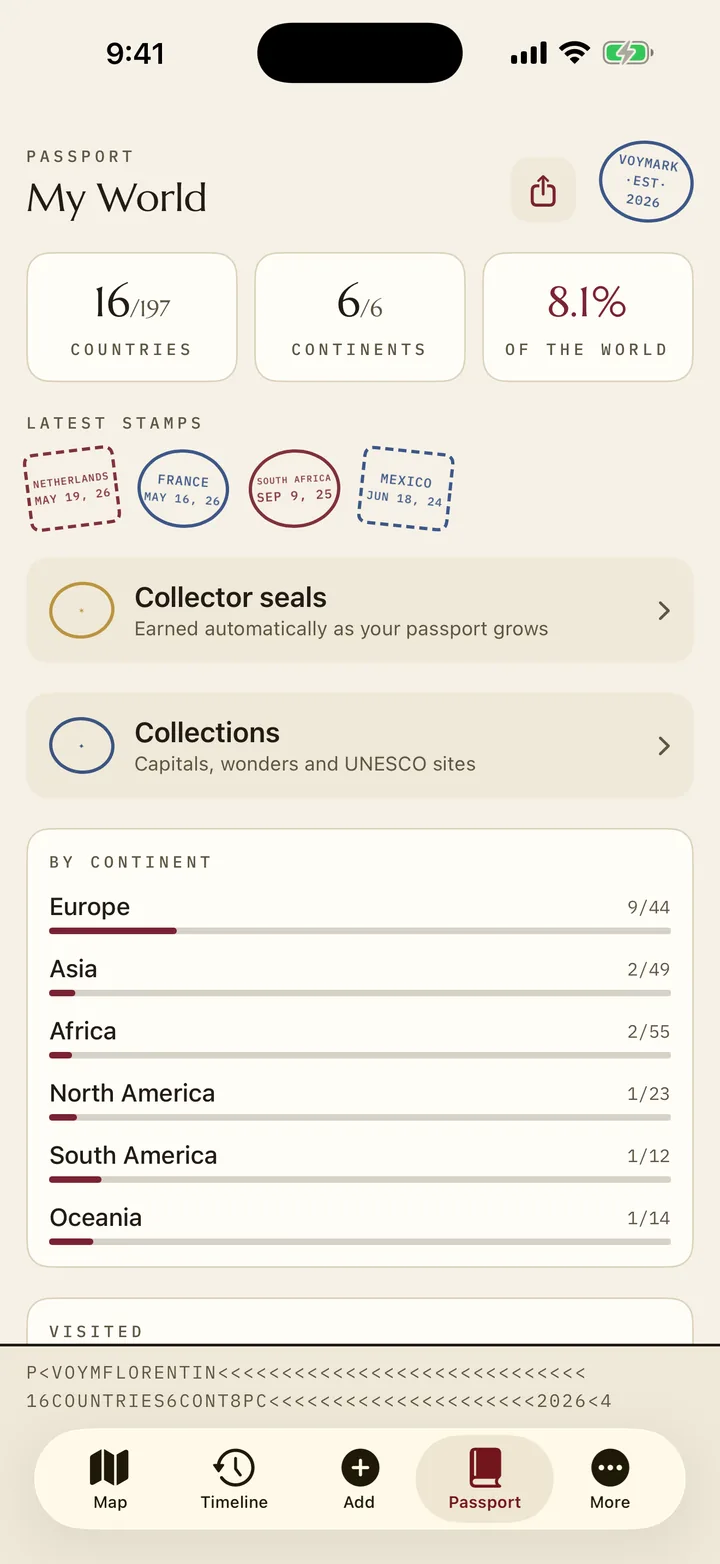
Your own number needs the same treatment: state the denominator. "Forty-one out of 197" is a fact; "forty-one countries" is a claim waiting to be argued with. Voymark carries the denominator everywhere the numerator goes, and lets you switch between all three definitions whenever you like.
There is a second question underneath, and it is the one that actually changes people's totals: does a layover count? That one is answered on the country counter page, where the six visit kinds live.